A single celestial apsara in ivory, turquoise and gold beside a moonlit lotus pool and heavenly palace; contemporary artistic interpretation

Celestial heritage · Hindu traditions

अप्सराएँ The Celestial Apsaras

Grace, artistry and stories from the heavenly realms

Meet the celestial beings who appear in Hindu literature through stories of heavenly courts, music, dance, sages and epic heroes. Each traditional account offers its own perspective.

Contemporary artistic interpretation · not a historical image

Beyond the legend

Who are the Apsaras?

Apsaras are celestial female beings found in Hindu literary traditions. Many accounts place them in heavenly realms and courts, where music, song and dance form part of celestial life. Other narratives give individual Apsaras important roles in events involving sages, kings and epic heroes.

The stories are not all alike. An Apsara may appear as a performer in a heavenly assembly in one passage and as a central figure in a particular narrative in another.

A note on tradition and identity Apsaras should not automatically be described as Devis or goddesses. Their identities and roles depend on the text and tradition being discussed. The summaries on this page distinguish specific textual accounts from broader cultural interpretation.

The names below are among the best-known Apsaras in epic and related traditions. The traditional contexts are named where relevant, so each account can be understood within its literary setting.

Four names · distinct traditions

Meet the Celestial Apsaras

These figures do not have identical stories or roles. Explore each name through a specific textual context.

01 · EPIC TRADITIONS

Urvashi

उर्वशी

Urvashi appears among the celestial figures of epic literature. Her story with Arjuna in Indra's realm is one of the best-known episodes associated with her; accounts explore desire, restraint and the relationships between celestial and human worlds.

Urvashi, a celestial apsara in ivory, turquoise and gold on a moonlit palace terrace; contemporary artistic interpretation
Urvashi · Contemporary artistic interpretation
02 · RAMAYANA

Menaka

मेनका

In the Valmiki Ramayana's Bala Kanda, Menaka is named as an Apsara in the account involving Vishvamitra at Pushkara. The episode and its consequences are retold with variations in later traditions.

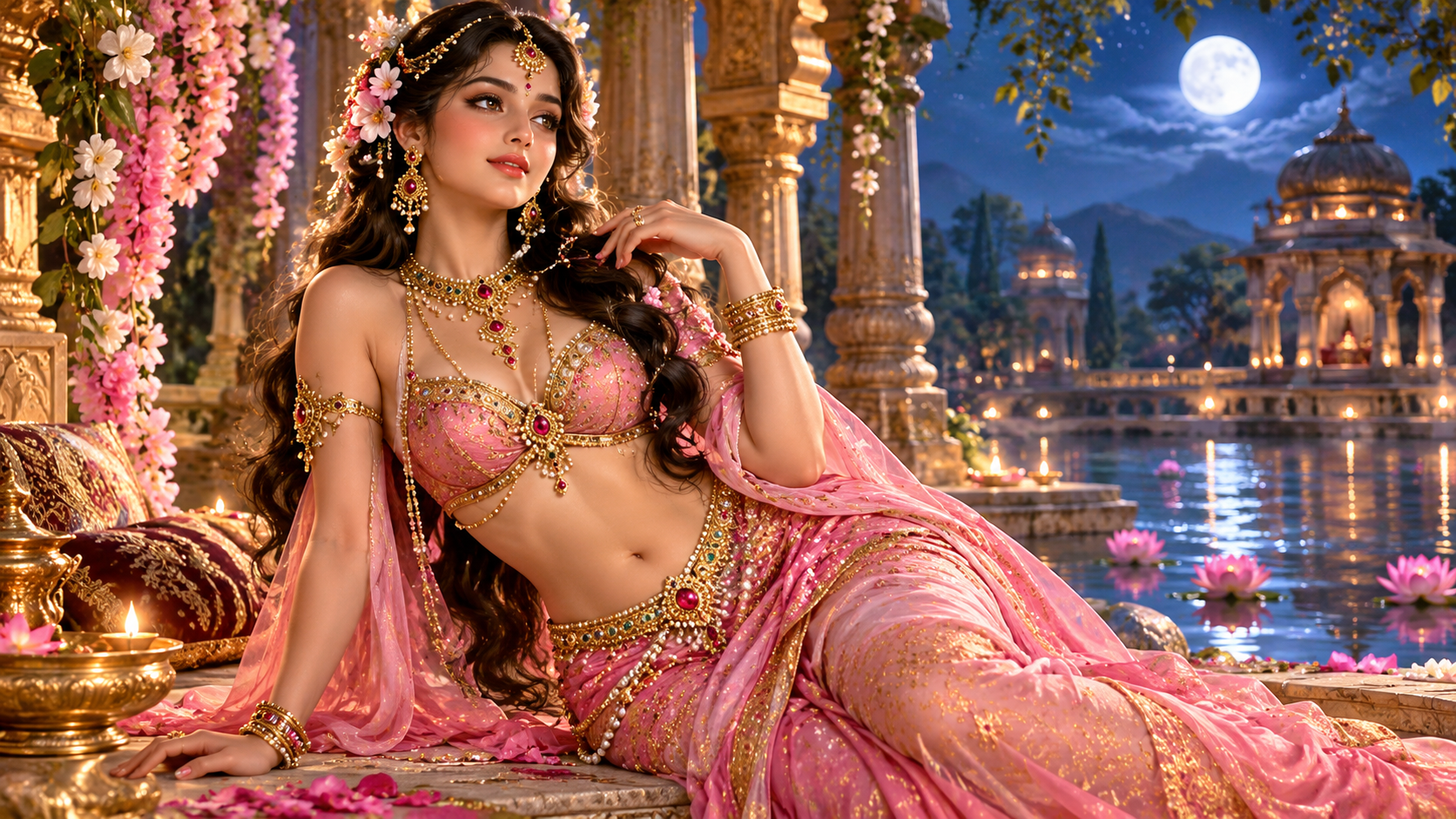
Menaka in a pink and gold celestial costume in a moonlit palace garden; contemporary artistic interpretation
Menaka · Contemporary artistic interpretation
03 · CELESTIAL ASSEMBLY

Rambha

रंभा

Rambha is named among the Apsaras attending Kubera, the lord of treasures, in the Mahabharata’s description of his celestial court. Other stories about her belong to different narrative settings, so her role should be read in context.

Rambha Apsara in a moonlit lotus garden; contemporary artistic interpretation
Rambha · Contemporary artistic interpretation
04 · MAHABHARATA

Tilottama

तिलोत्तमा

Tilottama is associated with the Mahabharata's wider narrative about Sunda and Upasunda. In the account, the attention she draws as she passes through a gathering forms part of the episode's unfolding.

Tilottama in an ivory and gold ensemble in a moonlit celestial garden; contemporary artistic interpretation
Tilottama · Contemporary artistic interpretation

Further names in textual traditions

More Apsaras to Explore

These additional profiles follow particular passages in the epics and Puranic literature. Their stories differ, and the cited passages do not provide an equally detailed biography for every figure.

MAHABHARATA · ADI PARVA

Ghritachi

घृताची

Ghritachi appears in the account of Drona’s birth. The narrative describes Bharadvaja encountering the Apsara at the Ganga and connects the episode with Drona’s unusual birth.

Textual reference: Mahabharata, Adi Parva, Chaitraratha Parva, Section 168 (Ganguli translation).

VALMIKI RAMAYANA · KISHKINDHA KANDA

Punjikasthala

पुञ्जिकस्थला

A verse in the Kishkindha Kanda identifies Punjikasthala with Anjana, the wife of Kesari. This provides a textual link between an Apsara’s name and the tradition surrounding Hanuman’s mother.

Textual reference: Valmiki Ramayana, Kishkindha Kanda 4.66.8.

BHAGAVATA PURANA · SKANDHA 5

Purvachitti

पूर्वचित्ति

Brahma sends Purvachitti to King Agnidhra while he is performing austerities. Their union becomes part of the Purana’s account of Agnidhra’s nine sons and their realms.

Textual reference: Bhagavata Purana 5.2, especially verses 3–14.

MAHABHARATA · SHALYA PARVA

Alambusha

अलम्बुषा

In a narrative concerning the sage Dadhichi, Indra sends Alambusha during the sage’s austerities. The episode links her appearance with the story of Sarasvata and the river Sarasvati.

Textual reference: Mahabharata, Shalya Parva, Section 51 (Ganguli translation).

BHAGAVATA PURANA · SKANDHA 4

Pramlocā (Pramlocha)

प्रम्लोचा

The Bhagavata Purana identifies Pramlocā as the Apsara whose union with sage Kaṇḍu resulted in a daughter. The text describes her leaving the child in the care of the forest trees before returning to the celestial realm.

Textual reference: Bhagavata Purana 4.30.13.

MAHABHARATA · ADI PARVA

Vishvachi (Viswachi)

विश्वाची

The Mahabharata names Viswachi among the foremost Apsaras. In the account of King Yayati, she is also mentioned as a celestial companion during his extended enjoyment of worldly pleasures, before he reflects on the limits of desire.

Textual reference: Mahabharata, Adi Parva, Sambhava Parva, Sections LXXIV–LXXV (Ganguli translation).

PADMA PURANA · UTTARA-KHANDA

Mañjughoṣā (Manjughosha)

मञ्जुघोषा

In the Padma Purana’s account set in Chaitraratha forest, Mañjughoṣā approaches the sage Medhavin while he is practising austerities. Her singing and music form part of a narrative about attraction, lost time and the consequences of attachment.

Textual reference: Padma Purana, Uttara-khanda, Chapter 46, verses 9–24.

MAHABHARATA · ADI PARVA

Sahajanya

सहजन्या

In the Mahabharata’s Adi Parva, Section CXXIII, Sahajanya is named among the celestial women who gather and sing during the celebrations of Arjuna’s birth. This passage records her as part of the group and does not provide a separate biography.

Textual references: Mahabharata, Adi Parva, Section LXXIV (Ganguli translation; six foremost Apsaras); Gita Press 1.123.66 (Arjuna’s birth celebration; numbering varies by edition).

VALMIKI RAMAYANA · AYODHYA KANDA

Mishrakeshi (Mishra Kesi)

मिश्रकेशी

Mishra Kesi is named among the celestial Apsaras invoked by the sage Bharadvaja while arranging a reception for Bharata and his retinue. The verse names her alongside Ghritachi, Vishvachi and Alambusha; it records her presence in a celestial gathering rather than providing a separate biography.

Textual reference: Valmiki Ramayana, Ayodhya Kanda, Sarga 91, verse 17.

MAHABHARATA · BOOK 13

Chitra

चित्रा

In a Mahabharata passage describing a celestial assembly, Chitra is named among the Apsaras who dance while Gandharvas play musical instruments. The passage records her as part of a group of celestial performers rather than giving her a separate biography.

Textual reference: Mahabharata, Book 13, Chapter 20, verses 19–21 (M. N. Dutt translation numbering).

MAHABHARATA · ADI PARVA

Adrika

अद्रिका

The Mahabharata describes Adrika as an Apsara transformed into a fish by a Brahmana’s curse. While dwelling in the Yamuna, she swallows the seed of King Uparichara Vasu; this episode forms part of Satyavati’s origin narrative.

Textual reference: Mahabharata, Adi Parva, Section LXIII (Ganguli translation; verse numbering varies by edition).

MAHABHARATA · ARJUNA'S BIRTH

Umlocā (Umlocha)

उम्लोचा

In an account celebrating Arjuna’s birth, Umlocha is named among the Apsaras who dance during the celestial festivities. This is a group appearance in the epic, not a separate biography of the Apsara.

Textual reference: Mahabharata, Arjuna’s birth celebration. Numbering varies by edition.

MAHABHARATA · ADI PARVA

Anavadyā (Anavadya)

अनवद्या

Anavadyā is named among the celestial Apsaras who perform at the celebration of Arjuna’s birth. Textual traditions differ in their account of her lineage, so this profile focuses on her appearance in the epic’s celebration narrative.

Textual references: Mahabharata, Adi Parva; Kinjawadekar 1.123.61 and 1.65.45; Siddhantabagish 1.117.65 and 1.60.46.

BHAGAVATA PURANA · SKANDHA 12

Anumlocā (Anumlocha)

अनुम्लोचा

The Bhagavata Purana names Anumlocā as the Apsara associated with the month Nabhasya. The passage places her within a roster of celestial attendants linked to the months; it does not provide a separate biography in this verse.

Textual reference: Bhagavata Purana 12.11.38.

MAHABHARATA · ADI PARVA

Vidyutparṇā (Vidyutparna)

विद्युत्पर्णा

The Mahabharata names Vidyutparna among the celestial Apsaras present at the celebrations associated with Arjuna’s birth. The passage records her as part of a gathered group and does not provide a separate biography.

Textual reference: Mahabharata, Adi Parva 1.123.66 (Gita Press numbering).

These summaries describe specific textual episodes; they are not a claim that every tradition tells each story identically.

Stories with textual context

Legends of the Celestial Court

Each story provides a concise introduction to its textual context. The summaries are not presented as verbatim translations.

01 Menaka and Vishvamitra · Valmiki Ramayana

In Bala Kanda, Sarga 63, Menaka comes to bathe at Pushkara. Vishvamitra sees her and invites her to stay at his hermitage; the passage says that years pass while she is there. This is one account of the episode, and later tellings may add or frame details differently.

02 Tilottama and the story of Sunda and Upasunda · Mahabharata

Tilottama's episode belongs to the Mahabharata's account of the brothers Sunda and Upasunda. The Adi Parva passage describes the celestial assembly turning to look as Tilottama passes. Her role is part of a larger story, not a stand-alone biography.

03 Urvashi and Arjuna · the celestial court

In the Mahabharata tradition, Urvashi's encounter with Arjuna takes place in Indra's celestial setting. The episode is often read in connection with Arjuna's response and a curse that later acquires significance during his period in disguise. Retellings and interpretations may emphasize different aspects.

Dance · music · visual culture

Apsaras in Art and Imagination

Literary descriptions and artistic depictions can illuminate one another, but they should not be treated as interchangeable evidence.

Music and performance

Many textual scenes place Apsaras among celestial performers. Song and dance help evoke the atmosphere of heavenly assemblies in those accounts.

Grace and movement

Flowing garments, poised movement and jewellery are recurring choices in modern artistic interpretations. Individual visual choices are artistic decisions unless supported by a specific historical source.

Temple and sculptural art

Indian art includes many celestial and dancing figures. A sculpture should not be identified as Urvashi, Menaka, Rambha or Tilottama without reliable evidence for that specific identification.

Reading the traditions carefully

Apsaras in Hindu Scriptures

Apsaras appear in several kinds of textual settings: Vedic dialogue, epic narratives, accounts of celestial assemblies, and Puranic stories. Their roles are not identical in every passage.

VEDIC DIALOGUE

Urvashi and Pururavas

Rigveda 10.95 presents a dialogue between Pururavas and Urvashi. It is a distinct textual setting from the Mahabharata episode involving Urvashi and Arjuna.

Reference: Rigveda, Mandala 10, Sukta 95.

EPIC NARRATIVE

Menaka and Vishvamitra

In the Valmiki Ramayana, Menaka comes to bathe at Pushkara and meets Vishvamitra during his austerities. The Mahabharata also recounts the story in its Shakuntala narrative.

References: Valmiki Ramayana, Bala Kanda 1.63; Mahabharata, Adi Parva, Sections 71–72.

EPIC NARRATIVE

Tilottama and the Asura Brothers

The Mahabharata recounts how Sunda and Upasunda become rivals over Tilottama, whose appearance contributes to the end of their alliance.

Reference: Mahabharata, Adi Parva, Section 214.

PURANIC NARRATIVE

Purvachitti and Agnidhra

The Bhagavata Purana describes Brahma sending Purvachitti to King Agnidhra. Their encounter forms part of the account of Agnidhra’s descendants.

Reference: Bhagavata Purana 5.2.3–14.

Section numbering can differ between editions and translations. The references identify specific passages, not a claim that every tradition preserves a single uniform account.

Questions and context

Frequently Asked Questions

What are Apsaras in Hindu traditions?

Apsaras are celestial female figures appearing in Sanskrit literature and related traditions. Their roles vary by story and can include participation in divine assemblies, music and dance, and episodes involving sages, kings or other celestial beings.

Do all Apsaras have the same role?

No. Individual passages give them different roles. A story involving austerities should not be treated as a complete description of every Apsara or every tradition.

Are Punjikasthala and Anjana connected in the Ramayana?

Yes. Valmiki Ramayana, Kishkindha Kanda 4.66.8–10 connects Punjikasthala with Anjana and describes her association with Kesari.

Why do Apsara lists differ between texts?

Different passages provide names for different narrative purposes. This archive presents named figures with specific textual references rather than claiming one universally definitive list.

Are the images authentic ancient depictions?

No. The artwork on this page is contemporary artistic interpretation. It should not be mistaken for a historical painting, archaeological object or precise scriptural description.

Textual reference guide

Sources & References

The following passages support selected profiles and narrative summaries on this page. These are textual references, not external website links.

  1. Rigveda — Mandala 10, Sukta 95: the Pururavas–Urvashi dialogue.
  2. Valmiki Ramayana — Bala Kanda 1.63: Menaka’s encounter with Vishvamitra at Pushkara.
  3. Valmiki Ramayana — Kishkindha Kanda 4.66.8–10: Punjikasthala and Anjana.
  4. Mahabharata, Adi Parva — Section 168 in the Ganguli translation: Ghritachi in the account of Drona’s birth.
  5. Mahabharata, Adi Parva — Section 214 in the Ganguli translation: Tilottama, Sunda and Upasunda.
  6. Mahabharata, Adi Parva — Sections 71–72 in the Ganguli translation: Menaka and Vishvamitra in Shakuntala’s account.
  7. Mahabharata, Vana Parva — Sections 45–46 in the Ganguli translation: Urvashi and Arjuna.
  8. Mahabharata, Sabha Parva — Section X in the Ganguli translation: Rambha is named among the Apsaras attending Kubera’s court.
  9. Mahabharata, Shalya Parva — Section 51 in the Ganguli translation: Alambusha, Dadhichi and Sarasvati.
  10. Bhagavata Purana — Skandha 5, Chapter 2, verses 3–14: Purvachitti and Agnidhra.
  11. Bhagavata Purana — Skandha 4, verse 30.13: Pramlocā and sage Kaṇḍu.
  12. Mahabharata, Adi Parva — Sections LXXIV–LXXV in the Ganguli translation: Viswachi is listed among the foremost Apsaras and later accompanies Yayati in Chittraratha’s gardens.
  13. Padma Purana — Uttara-khanda, Chapter 46, verses 9–24: Mañjughoṣā and sage Medhavin.
  14. Mahabharata, Adi Parva — Section LXXIV in the Ganguli translation names Sahajanya among the six foremost Apsaras; Gita Press 1.123.66 also includes her among Apsaras at Arjuna’s birth celebration. Numbering differs by edition.
  15. Valmiki Ramayana — Ayodhya Kanda, Sarga 91, verse 17: Mishra Kesi named among celestial Apsaras invoked by Bharadvaja.
  16. Mahabharata — Book 13, Chapter 20, verses 19–21 (M. N. Dutt translation numbering): Chitra among Apsaras dancing to Gandharva music.
  17. Mahabharata, Adi Parva — Section LXIII in the Ganguli translation: Adrika, an Apsara transformed into a fish by a Brahmana’s curse.
  18. Mahabharata — Arjuna’s birth celebration: Umlocha named among dancing Apsaras. Edition numbering varies; Kinjawadekar 1.123.65, Siddhantabagish 1.117.69, and Gita Press 1.123.66 (where the name appears as Umlocā).
  19. Mahabharata, Adi Parva — Kinjawadekar 1.123.61 and 1.65.45; Siddhantabagish 1.117.65 and 1.60.46: Anavadyā named among Apsaras and in the account of Arjuna’s birth celebration. Gita Press 1.123.66 lists Anavasadyā; because the spellings differ, this page does not assume they refer to the same figure.
  20. Bhagavata Purana — Skandha 12, Chapter 11, verse 38: Anumlocā named as the Apsarā associated with the month Nabhasya.
  21. Mahabharata, Adi Parva — 1.123.66 (Gita Press numbering): Vidyutparna named among the Apsaras at Arjuna’s birth celebration.

English section numbers above follow the cited translation where specified. Other editions may divide or number passages differently. Where traditions vary, the page avoids treating one retelling as universal.

A living cultural imagination

Beyond beauty, a world of stories

The Apsaras of Hindu traditions cannot be reduced to a single image or role. Their stories connect celestial worlds with questions of art, aspiration, restraint, relationships and the varied imaginations of epic literature.

The hero artwork is a contemporary generated interpretation, not an authentic ancient painting, sculpture or historical photograph.